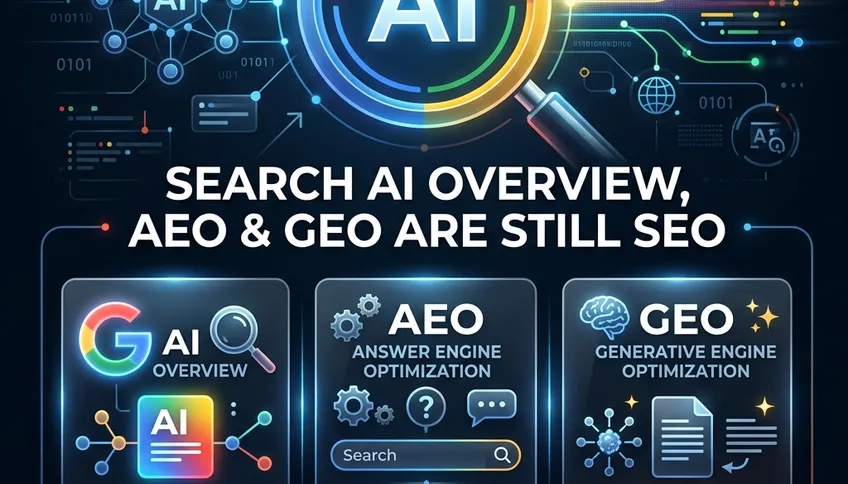
In March 2026, 48% of Google searches already showed an AI response at the top of the page. In December of last year, it was 34.5%. The change is accelerating, and with it came an entire industry of new acronyms: AEO (Answer Engine Optimization), GEO (Generative Engine Optimization), LLMO… and the services selling them.
Google decided to cut straight to the point with an official guide titled “Optimizing your website for generative AI features on Google Search”, published on May 15, 2026. What it says is as much about what to do as, above all, what to stop doing.
The Core Message: AEO and GEO Are Not New Disciplines
Google states it bluntly in its official documentation: optimizing for generative AI search is optimizing for the search experience, and therefore is still SEO.
“From Google Search’s perspective, optimizing for generative AI search is optimizing for the search experience, and thus still SEO.” — Official Google Guide, May 15, 2026
This has concrete implications for any business considering paying for specialized “GEO” or “AEO” services for Google: for Google properties, those services are not doing anything different from what good SEO should already cover.
The Myths Google Officially Debunks
This is perhaps the most valuable section of the guide: Google explicitly lists the tactics that the industry has been promoting that are unnecessary for its systems.
❌ The llms.txt File
Google does not read it in any special way. The crawler can discover it like any other text file, but it does not assign any significance to it for inclusion in generative responses.
If you have already published it, there is no harm in keeping it—it can serve as a signal of transparency for other AI operators (like ChatGPT or Perplexity, which may respect it). But redirect the time you spent on it toward original content and solid technical SEO.
❌ Content Chunking
It is not necessary to break down content into small pieces “so the AI understands it better.” Google’s systems are capable of understanding pages with multiple topics and extracting the relevant snippet on their own. Danny Sullivan, Google’s search liaison, confirmed this in January 2026: chunking adds no value and often hurts editorial quality.
❌ Special Schema for AI
There is no specific schema.org markup for generative AI features. Structured data remains useful for rich results in classic search, but it has no special effect on AI Mode or AI Overviews.
❌ Pages for Every Long-Tail Variant
Covering every long-tail variation with separate pages falls under the “scaled content abuse” spam policy—one of the most aggressive entries in Google’s anti-abuse system. The framework rewards a few solid articles over hundreds of thin pages.
What Actually Matters
The signals Google confirms as relevant for appearing in generative responses are exactly those of high-quality technical SEO:
Unique and useful content. Content that cannot be found elsewhere has a structural advantage in AI citations. Brands cited in AI responses see their click-through rates grow by 35% compared to the baseline organic result.
Clean indexing and correct crawling. Pages must be indexed and eligible for snippets. The same crawler that feeds classic search feeds AI responses—there is no parallel index.
Semantic HTML and accessibility. AI agents read sites via screenshots, the DOM, and the accessibility tree. A site with well-structured HTML, correct tags, and keyboard navigation is a better candidate for being read and interpreted correctly.
Page experience (Core Web Vitals). Loading speed, visual stability, and interaction responsiveness remain direct signals of quality.
Google Business Profile and Merchant Center. For local businesses and e-commerce, these listings directly feed generative AI responses. Google dedicates a specific section to this in the guide.
The Next Front: Agentic Experiences
The guide dedicates a new section—the most forward-looking one—to agentic experiences: autonomous AI systems that can book appointments, compare products, or complete tasks on behalf of users directly from search.
For websites, this means that soon it won’t just be humans visiting—it will be agents. And those agents need a clean DOM, correct accessibility, and predictable structures to work well. Those who build well today will be ready for that scenario.
Web accessibility stops being just an ethical best practice and becomes a real visibility factor in the agentic AI ecosystem Google is actively building.
The Most Uncomfortable Number
93% of searches that show an AI response do not generate a click to the website. This is the metric that explains why organic traffic for many sites drops even if their rankings have not worsened.
Google’s response is not to ignore it, but to adapt the success metric: brands cited in AI responses gain brand visibility and, according to public data from companies like NerdWallet and HubSpot, can see a drop in traffic alongside an increase in conversions—users who visit less frequently but with higher intent.
Conclusion
Google’s guide is not a surprise to those who have been practicing high-quality technical SEO for years. It is, however, important news for those who got carried away by the noise of new acronyms or invested in tactics that promised shortcuts.
The message is simple: build content that deserves to be cited, keep your technical house in order, and your presence in generative responses will follow the same path as your SEO. There is no parallel channel, no magic file, no secret schema.
Want to understand the fundamentals of AEO before this news? Read From SEO to AEO: The New Strategy to Be the AI’s Favorite Answer. And if you are looking for the complete foundation of organic positioning, don’t miss our Ultimate On-Page SEO Guide for 2025.
Sources: Official Google Guide — “Optimizing your website for generative AI features on Google Search” (May 15, 2026) · Search Engine Journal · Search Engine Land · SEO.com Data (March 2026).
Need to align your website with Google’s latest standards? Discover our SEO Service or check out our high-performance solution, Portal Web Performance.