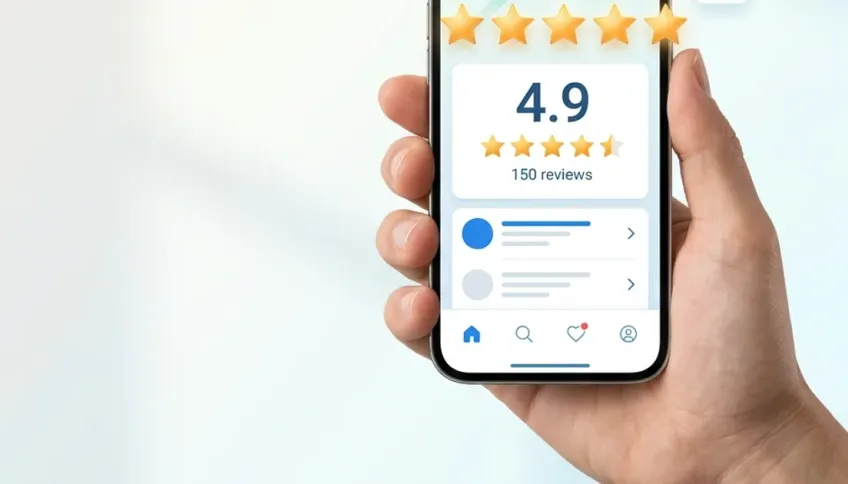
Quick answer: Google reviews increase your sales in two ways at once: they rank you higher in local search and on Google Maps, and they convince hesitant prospects to choose you. To get them safely, ask right after a positive experience, share your direct review link via WhatsApp or email, personalize the message, and respond to every review. Never buy reviews or incentivize them with discounts or gifts: Google detects this and can suspend your profile.
Before buying a product, booking a hotel, hiring a lawyer, or choosing a restaurant, most people do exactly the same thing: they look up reviews on Google. Think about your own behavior. If you find two similar businesses and one has 5 reviews while the other has 150 positive ratings, which one earns your trust? Your customers do the exact same thing with you.
In this guide you will understand why reviews directly impact your sales, how to get authentic reviews step by step, and which practices to avoid to protect your business from possible Google penalties. This is the companion to our guide on creating and optimizing your Google Business Profile—if you don’t have your profile set up yet, start there.
Why Google Reviews Directly Impact Your Sales
Reviews do two things at the same time, and both translate into money.
1. They rank you higher on Google. When someone searches for “restaurant near me,” “lawyer in the city,” or “digital marketing agency,” the algorithm decides which businesses to show first based on—among other factors—the quantity of reviews, their quality (the star rating), and the frequency of new opinions coming in. A profile with constant activity tells Google the business is relevant and trustworthy today, not three years ago. That’s why a business with 50 reviews at 4.5 stars almost always beats one with 5 perfect but stagnant reviews.
2. They convince the customer to choose you. Ranking first is only the first step. Reviews are what tip the scale. People know any company will speak well of itself; what truly drives a purchase decision is the experience of other users. An authentic review answers the questions no ad can: Do they deliver on their promises? Is the service good? Do they deliver on time? Is it worth investing with them?
When both factors work together, a virtuous cycle of growth begins:
More and better reviews → greater visibility on Google → more profile visits → more calls and contacts → more satisfied customers → more reviews.
This process feeds itself. That’s why many businesses leading their sector aren’t the biggest—they’re the ones that manage their digital reputation best.
The Mistake Almost Everyone Makes: Waiting for Reviews to Arrive on Their Own
Most businesses believe that providing excellent service is enough to receive positive reviews. Reality is different.
A fully satisfied customer usually considers the transaction done and returns to their routine without leaving a comment. A frustrated customer—annoyed by a delay or a misunderstanding—feels a far stronger emotional impulse that drives them to write a review immediately.
This creates a dangerous imbalance: if you only let reviews arrive on their own, you end up with a higher proportion of complaints than praise, even when most of your customers are happy. Not because your service is bad, but because happy customers stay silent.
The solution is not to wait. It is to ask—the right way.
How to Ask for Reviews Without Violating Google’s Policies: Step by Step
Google allows you to request reviews from your customers. What it prohibits is manipulating them. The difference is crucial. Follow these steps to get authentic, safe reviews:
-
Ask at the right moment. The best time is right when the customer has just expressed satisfaction: after delivering a product, finishing a service, when they thank you, or right after you’ve solved a problem for them. That’s when their willingness is highest.
-
Use your direct review link. Go to your Google Business profile dashboard, find the “Share review form” option, and copy that short link. When you send it to the customer, it takes them straight to the rating window without having to search for your business. Every step you save raises the response rate.
-
Send it through the channel your customer already uses. WhatsApp, email, or SMS. A short, genuine message works best: “Hi [Name], we were thrilled to help you with your project. Your opinion really matters to a local team like ours. Would you support us with a quick review of your experience here? [link]”.
-
Make it personal, not mass. Mention the customer’s name and the service they received. Personalization doubles the chances of a response compared to a generic blast to a hundred people.
-
Make it easy, don’t pressure. Reminding once is fine. Insisting repeatedly is annoying and can backfire (even triggering a negative review out of frustration). The customer experience always comes before getting the review.
What You Should NEVER Do
Google invests millions in AI systems dedicated to detecting fraudulent patterns. These mistakes can cost you the permanent suspension of your profile:
- Don’t buy reviews. Networks of fake accounts are easy to identify and usually end with the profile being removed from the maps.
- Don’t offer money, discounts, or gifts in exchange for opinions. Incentivizing a review through compensation explicitly violates Google’s policies. The opinion must be disinterested.
- Don’t create fake reviews from your own or employee accounts. Self-praise is detectable through data cross-checks and ruins your credibility.
- Don’t concentrate reviews on one device or network. A tablet in your store where everyone rates from the same IP raises immediate suspicion: Google flags them as spam and deletes them.
How to Respond to Reviews (and Why It Matters So Much)
Getting the review is half the job. The other half is responding to it. Google values a business’s interaction with its reviews as a signal of activity and commitment, and your responses are visible to every future customer.
| Type of review | Response approach |
|---|---|
| Positive | Genuine, personalized thanks. Avoid the repeated template; mention specific details of their experience. |
| Negative | Professionalism, empathy, and composure. Acknowledge the situation, offer a solution, and redirect the case to a private channel. |
For positive reviews: thank them authentically. If a customer took the time to write three paragraphs, respond by mentioning concrete details of their visit. That builds loyalty and shows readers you pay attention.
For negative reviews: this is your brand’s test of maturity. A well-handled criticism can become your best sales tool, because many prospects read precisely the worst comments to gauge how you react.
Golden rule: never respond defensively or out of anger. Stay calm, take responsibility if there was a failure, offer a sincere apology, and invite them to continue the conversation via email or phone. Readers judge your attitude—not just the problem.
Turn Reviews Into Content That Sells
Good reviews are free testimonials you can reuse far beyond Google. Each positive opinion is a piece of User-Generated Content (UGC), one of the highest-converting formats out there, precisely because you didn’t create it.
- On your website — a carousel or screenshots of real reviews on your homepage breaks down objections right when the customer is deciding whether to hire you.
- On social media — sharing a satisfied customer’s exact words acts as a constant validator of your quality.
- In your sales proposals — a real quote inside a quotation adds institutional weight and helps you close deals.
Leveraging the voice of your own buyers turns past good experiences into the most persuasive sales arguments of the present.
How Many Reviews Does a Business Really Need?
There is no magic number. Competitive businesses tend to accumulate dozens or hundreds of reviews. But more important than reaching a figure is maintaining a consistent strategy.
Google especially values:
- Natural, progressive growth.
- Recent reviews.
- Ongoing business interaction.
- Detailed opinions.
Ten new reviews each month add more value than a hundred gained suddenly—which would also trigger fraud alerts.
Frequently Asked Questions About Google Reviews
Can I ask my customers for reviews? Yes, as long as there’s no manipulation or incentive. Asking for an opinion right after a good experience and sharing your direct link is allowed. Buying reviews, giving discounts in exchange, or creating fake reviews is not.
Do reviews help with local SEO? Yes. Quantity, quality, and frequency are among the most relevant factors for your visibility in local search and on Google Maps.
Does Google remove fake reviews? Yes. It detects suspicious patterns and can remove opinions and even suspend the business profile.
Do negative reviews hurt my business? Not necessarily. A professional response can turn a criticism into a public demonstration of good service.
How long does it take to see the impact? It depends on the industry and competition, but many businesses notice improvements in visibility and inquiries within the first few months.
Reviews aren’t luck—they’re strategy. Every new positive opinion strengthens your digital reputation and makes it easier for the next customers to choose you over the competition.
At Web Booster we help businesses optimize their Google Business Profile, improve their local ranking, and design ethical review-generation strategies that comply with Google’s policies and deliver sustainable results.
👉 Ask for personalized advice via WhatsApp: Message us here