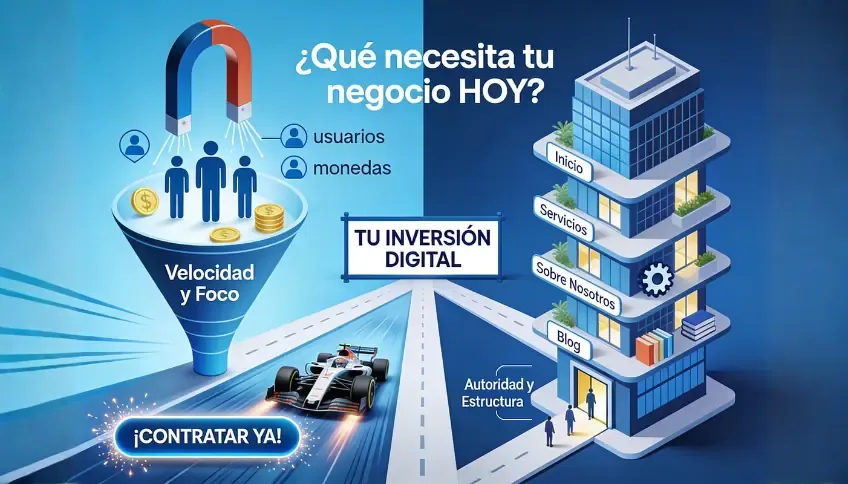
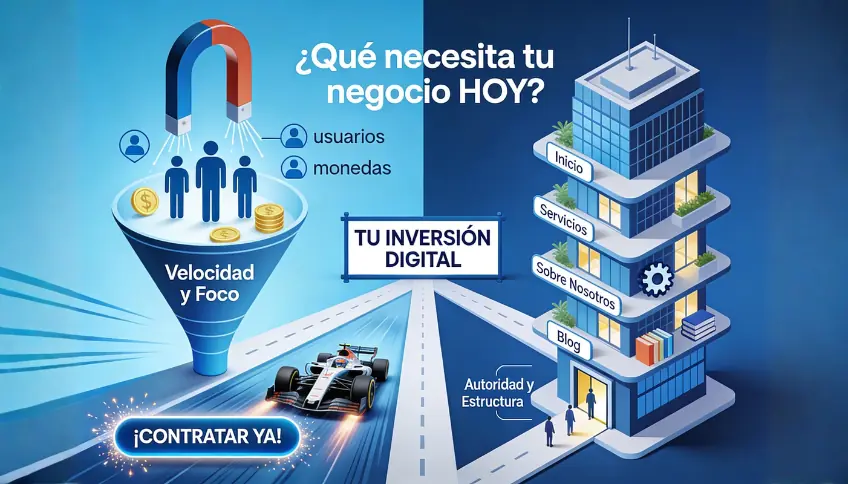
When a company decides to grow online, it always reaches the same fork in the road. To the left, the immediate conversion funnel—speed, focus, results today. To the right, the authority building—structure, credibility, ranking that lasts for years. In the middle, your digital investment waiting for you to make the right choice.
Which one do you choose? The honest answer is: it depends on where your business is at right now. But there is a very clear way to find out.
“The mistake is not in choosing poorly—it is in not understanding that a landing page and a website have completely different goals. One converts today. The other builds for tomorrow.”
The Landing Page: Speed and Focus
A landing page is a page designed with a single mission: to get the visitor to perform a specific action and nothing else. No navigation menu. No other sections. No distractions. Everything—the headline, the images, the text, the button—points to a single goal: for the user to buy, register, call, or request information.
It is the Formula 1 car of your digital strategy: designed to go fast in one direction, optimized down to the last detail to win the race.
Speed & Conversion
Landing Page
One page, one offer, one action. Without distractions, all focused on converting the visitor.
When to use it?
- Campaigns on Google Ads or Meta Ads
- Launches of a specific service
- You need clients this week
- You want to measure ROI with precision
- One-off or limited-time offer
The Full Website: Authority and Structure
If the landing page is the F1 car, the full website is the corporate building: it has a ground floor (home), upper floors (services, about us, blog), and a permanent entrance open to anyone who comes looking. It is your long-term digital presence.
Google indexes it. Customers browse it before making a decision. Business partners evaluate it. A well-built website works for your brand 24/7, even when you are not looking—just like the Web portals we build at Web Booster.
Authority & Structure
Full Website
Your digital headquarters. Where your story, services, portfolio, and credibility live.
When to use it?
- Organic ranking in Google (SEO)
- You offer multiple services or products
- Your customer researches before buying
- You want to build a brand for the long term
- You need to show track record and portfolio
The Differences That Matter
| Feature | Landing Page | Full Website |
|---|---|---|
| Primary Goal | Immediate conversion | Ranking and authority |
| Navigation | None—no distractions | Full menu |
| Content | One offer, one CTA | Multiple sections and services |
| Traffic Source | Paid advertising (Ads) | Organic search (SEO) |
| Time for Results | Days or weeks | 3 to 6 months (SEO) |
| Implementation Cost | Lower | Higher |
| ROI Measurement | Direct and precise | Indirect and cumulative |
| Ideal for | Campaigns and launches | Brand and sustainable growth |
Which One Do You Need, According to Your Stage?
There are three typical scenarios. Identify which one you are in:
You need clients this week
You have a clear service, you are going to invest in advertising, and you want measurable results quickly. The landing page is your path. It is the most efficient tool for converting paid traffic into real clients.
You want to build a solid presence
You offer several services, your customer researches before buying, and you want to appear in Google organically. The full website is what you need. It is the most valuable digital asset in the long term.
You want to dominate your market
The ideal scenario: a website as your authority base and specific landing pages for each campaign or service. It is the structure used by companies that grow consistently. Both tools, each in its role.
⚠️ The most costly mistake companies make
Creating a website and waiting for it to sell on its own—or investing in advertising while sending traffic to pages that are not designed to convert. The problem is not the budget or the product: it is that the digital tool is not aligned with the goal. A generic landing page does not sell. A website without a traffic strategy reaches no one.
The Key Is Not the Tool—It Is the Strategy
Neither of the two options works alone if there is no strategy behind it. A landing page without well-targeted traffic is an empty page. A website without valuable content or SEO structure is an expense, not an investment.
What makes the difference is having clarity on the objective, the audience, and the stage of the business—and then choosing (and building) the right tool for that specific context.
At Web Booster, what we do is not simply “create web pages.” We design the digital infrastructure your business needs based on where you are standing today and where you are going. Sometimes that’s a high-converting landing page. Other times it’s a strategic website. And often it is the combination of the two, well-integrated.
Not sure which one you need?
Tell us where your business is at, and we'll tell you exactly which digital tool makes the most sense for your stage—no runarounds and no cost.
Talk to a Web Booster strategistNo obligation · Response in less than 24 hours